IELTS Speaking Cue Cards: Topic Part 2 Practice Guide
Every topic part 2 IELTS speaking task follows the same format: you receive a cue card, get one minute to prepare, and then speak for up to two minutes. That sounds simple enough. In practice, most candidates either run out of things to say after 40 seconds or talk in circles without answering the actual prompts.
This guide cuts through both problems. You will find the five core cue card topic types that cover the vast majority of what appears in real exams, practical preparation strategies, and a clear explanation of what examiners actually listen for during Part 2.
Understanding topic part 2 IELTS speaking: format and what examiners assess
Part 2 is officially called the "long turn." The examiner hands you a card with a topic and three or four bullet-point prompts beneath it. You have one minute to prepare, and you may make notes on paper provided. Then you speak for one to two minutes. The examiner will not interrupt, though they may ask one or two brief rounding-off questions at the very end.
Four criteria determine your score across the entire Speaking test (Source: IELTS.org , official band descriptors):
- Fluency and coherence , how smoothly and logically you speak
- Lexical resource , the range and accuracy of your vocabulary
- Grammatical range and accuracy , the variety and correctness of your sentence structures
- Pronunciation , how clearly and naturally you produce sounds and stress
Part 2 is where fluency and lexical resource are most visible, because you have uninterrupted time to demonstrate both. A candidate speaking about a mundane topic with varied grammar, precise vocabulary, and natural flow will outscore someone with an impressive topic delivered in hesitant, repetitive sentences.
One important point: examiners are trained to detect memorised responses. Rehearsed scripts sound flat and unnatural, and they are penalised under fluency. Prepare ideas, vocabulary, and examples, not word-for-word answers.
For a full breakdown of the Speaking test across all three parts, explore our complete IELTS speaking guide.
The one-minute preparation strategy
Do not spend 60 seconds staring at the card in a panic. Work through it systematically:
- Read the main topic sentence (10 seconds)
- Identify each bullet-point prompt and underline key words (10 seconds)
- Brainstorm one or two specific examples for each bullet point (20 seconds)
- Jot down keywords only, not full sentences (10 seconds)
- Mentally order your response (10 seconds)
That structure turns one minute into a usable plan rather than wasted time.
The two-minute timing challenge
Two minutes feels long until you are in the exam room. A rough framework:
- First 20 to 30 seconds: Introduce the topic and address the main prompt directly
- 60 to 90 seconds: Develop your examples, add detail, and explain connections
- Final 10 to 20 seconds: A brief conclusion or reflection
Practise with a timer at home until the rhythm becomes natural.
The 5 core topic types for topic part 2 IELTS speaking
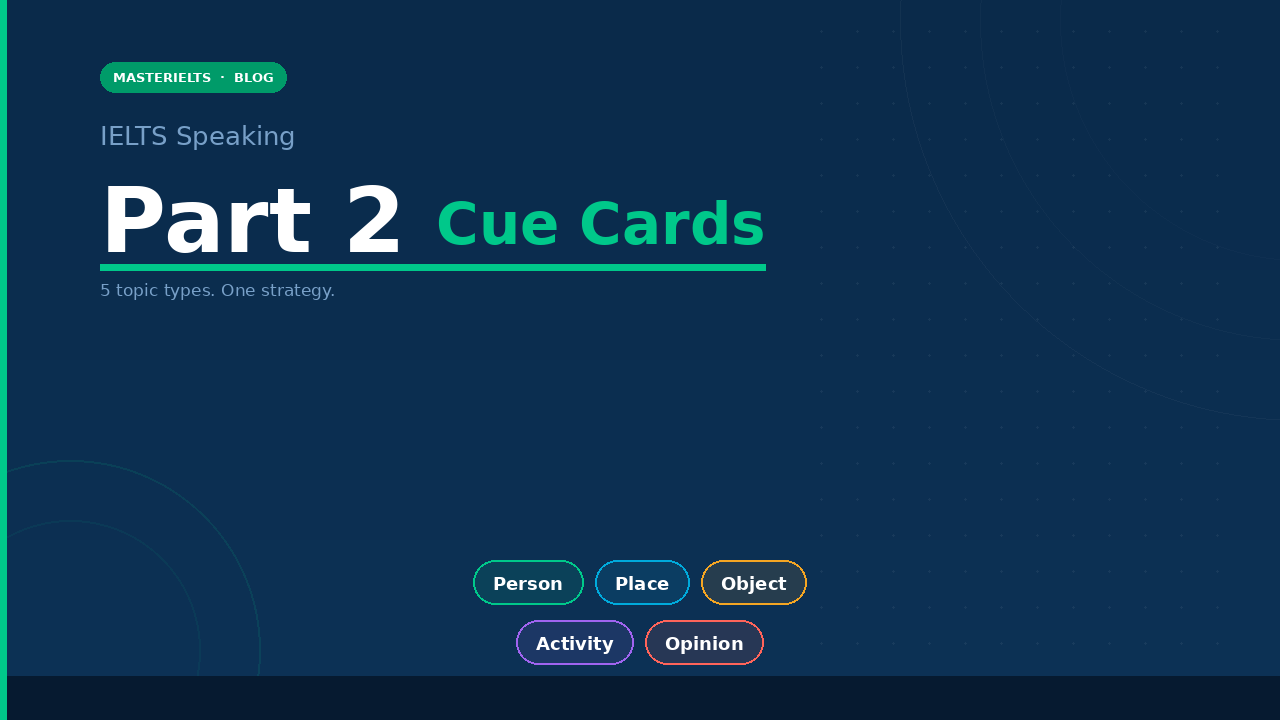
Analysing the topics that appear across real IELTS exams reveals a clear pattern: nearly every cue card belongs to one of five categories. You will rarely encounter the exact same topic twice, but if you have prepared one strong "person" response, you can adapt it to almost any person-type card.

Person topics
These cue cards ask you to describe someone: a family member, a friend, a teacher, a public figure, or someone you admire. The structure is almost always the same regardless of the specific prompt: introduce the person, describe their qualities or what they do, explain your relationship or how you know them, and say why you find them interesting or admirable.
Where candidates lose marks here is by being vague. Saying "she is kind and helpful" tells an examiner nothing. Saying "she once spent an entire weekend helping me prepare for a university application she knew nothing about, just because she could see I was stressed" tells a story and shows lexical range.
Prepare a small set of people from different areas of your life: a family member, a friend, a mentor, and a public figure. You can adapt these to fit almost any person-type prompt.
Place topics
Place cue cards ask you to describe somewhere you have visited, a building, a natural setting, a restaurant, or a peaceful spot. The underlying structure: where it is, what it looks like or what makes it distinctive, what you or others do there, and why it matters to you.
Sensory details transform place descriptions. "It was beautiful" tells an examiner little. "The air smelled of salt and the light had that particular flat quality you only get on overcast days near the sea" demonstrates vocabulary range and creates a vivid, coherent picture.
Practise using relative clauses and descriptive adjectives for this topic type; they appear naturally in place descriptions and push grammatical range scores upward.
Object and possession topics
These cards ask you to describe something you own, something you were given, or an object that matters to you. Common variants include a useful object, a piece of technology, a gift, a photograph, or something with sentimental value.
This topic type lends itself naturally to a mix of past and present tenses: when you received or discovered the object, what it looks like now, how you use it, and why it has meaning. Functional vocabulary (durability, purpose, craftsmanship, aesthetic) fits here and helps with Lexical Resource scores.
Activity and experience topics
These ask you to describe a hobby, a memorable event, a journey, a time you tried something new, or an exciting experience. Narrative structure is essential: what happened, when, where, with whom, and why it mattered to you.
Linking words carry particular weight in activity topics. Words and phrases like first, once I arrived, eventually, as a result, and by the end create coherence and signal to examiners that you can organise extended speech logically. Emotional language and personal reflection also help; they demonstrate that you are speaking authentically rather than reciting a rehearsed list.
Opinion and preference topics
These cue cards ask you to describe something you would like to do, a skill you want to learn, a place you have always wanted to visit, or a change you would like to see. They require conditional and hypothetical language: if I had the chance, I would probably, ideally, I would like to.
The error most candidates make with opinion topics is stating the preference without explaining the reasoning. The why is where Lexical Resource scores improve. "I would like to learn to play the piano because my grandmother played and I always connected it with a sense of calm I find difficult to recreate any other way" is far more effective than "I would like to learn piano because it is a beautiful instrument."
Part 3 connection: preparing for the discussion that follows
Part 2 and Part 3 are directly linked. Once you finish your long turn, the examiner moves immediately into Part 3 discussion questions on the same general theme. Understanding this connection helps you prepare more effectively.
For a person topic, Part 3 might ask: "What qualities do you think make someone a good role model?" or "How has social media changed the way people form friendships?" For a place topic: "Do you think cities have become too crowded?" or "How important is it to preserve historic buildings?"
The pattern is consistent: Part 2 asks about your personal experience (concrete), while Part 3 asks you to generalise, compare, or analyse (abstract). Examiners use Part 3 to differentiate Band 6 and Band 7+ candidates, because abstract discussion requires more sophisticated language.
When you prepare a Part 2 topic, spend a few minutes also thinking about the broader themes it connects to. That thinking feeds directly into both a richer Part 2 response and a more confident Part 3. For specific Part 3 practice questions grouped by topic, see our guide to IELTS part 2 speaking questions.
Common pitfalls and how to avoid them
A look at what the top-ranking IELTS preparation resources get right reveals a consistent gap: they list topics but rarely explain what goes wrong. Here are the mistakes that actually cost candidates marks in Part 2:
Ignoring the bullet points. The prompts on the cue card are not decorative. They structure your response and signal to the examiner that you understood the task. Work through each one.
Running out of things to say. This usually happens when candidates choose a vague example. The more specific your example, the more you have to say. Name the person, the place, the occasion. Specific details generate more speech than abstract generalisations.
Vocabulary repetition. Using the same adjectives repeatedly (nice, interesting, good, beautiful) signals a narrow lexical range regardless of how accurate they are. Prepare synonyms and collocations before the exam.
Grammatical monotony. A string of short simple sentences lowers your Grammatical Range score even if they are all correct. Vary your structures: use relative clauses, conditionals, reported speech, and complex sentences with subordinate clauses.
Stopping abruptly. Running out of steam and simply stopping with 30 seconds still on the clock wastes an opportunity. Use the final stretch for reflection: "Looking back, I think what I valued most about that experience was..." gives you 15 to 20 seconds of natural, coherent extension.
Frequently asked questions
What topics come up most often in IELTS Speaking Part 2?
Person, place, object, activity, and opinion topics account for nearly all Part 2 cue cards (Source: analysis of Cambridge IELTS official practice test banks, Books 1 to 18). Person and experience topics appear most frequently. Preparing flexible examples across all five types gives you strong coverage without needing to memorise dozens of individual topics.
How long should I speak in Part 2?
You should aim to speak for the full two minutes. The examiner will signal when your time is up. Speaking for less than 90 seconds suggests you have not fully developed your response. Practise at home with a timer until sustaining two minutes feels natural rather than forced.
Can I use notes during Part 2?
Yes. You will be given paper and a pencil for the one-minute preparation time. Use them to write keywords, not full sentences. Note-writing during your actual response is not permitted, but referring to keywords you have already written is fine.
Will the examiner help me if I get stuck?
No. The examiner will not prompt or assist during your Part 2 response. If you lose your train of thought, use a brief recovery phrase such as "Where was I? Yes, the reason I particularly remember this is..." and continue. Practising recovery phrases reduces panic if it happens in the exam.
Does the Part 2 topic affect my score?
No. You are scored on how you speak, not what you speak about. There are no preferred or penalised topics. An articulate, well-organised response on a simple topic outscores a stumbling, vocabulary-poor response on an impressive one.
Conclusion
IELTS Speaking Part 2 rewards preparation that is strategic rather than exhaustive. You do not need to memorise 100 separate topics. You need to understand the five core topic types, prepare flexible personal examples for each, and practise the one-minute preparation routine until it is automatic.
Mastering topic part 2 IELTS speaking comes down to three habits: record yourself speaking and listen back critically, practise with a timer every time, and always prepare your Part 3 connection questions alongside your Part 2 response. Do those three things consistently over four to six weeks and you will notice real gains in fluency, coherence, and vocabulary range.
For broader preparation across all three parts of the test, our complete IELTS speaking guide is the place to start at Master IELTS.